18:00 Chievo - Udinese
18:00 Parma - Cagliari
20:45 Catania - Atalanta
20:45 Napoli - Novara
Showing posts with label Italy. Show all posts
Showing posts with label Italy. Show all posts
Saturday, April 21, 2012

Wednesday, April 18, 2012
Juve Stabia stadium - Stadio Menti

The Stadium "Romeo Minds" of Castellammare, is one of the three stages dedicated to Romeo Minds, as even the stage of Montichiari, near Brescia, and Vicenza are dedicated to the player who tragically died in Vicenza "Massacre of Superga" . It has a capacity of 12,800 seats, even if Juve Stabia from the 2010-2011 season has reduced the seating capacity to 7,642.
Brescia stadium - Stadio Mario Rigamonti
In the fifties the municipal government decided to build a new stadium to replace the existing at the time, the Stadium of Viale Piave.
In April of 1956 began work on the extension of an existing system in 1928 that ended three years later (in 1959), making it possible for the local team to play in the new facility the Serie B.
It was so named in memory of Mario Rigamonti Brescia player, who played in Grande Torino and died in the Superga tragedy of 1949.

Source - www.comune.torino.it
In April of 1956 began work on the extension of an existing system in 1928 that ended three years later (in 1959), making it possible for the local team to play in the new facility the Serie B.
It was so named in memory of Mario Rigamonti Brescia player, who played in Grande Torino and died in the Superga tragedy of 1949.

Source - www.comune.torino.it
Varese stadium - Stadio Franco Ossola
The plant, built in 1925 and renovated several times (the last time in the '60s), is dedicated to Franco Ossola, Varese football player who died in the Superga tragedy, that took the life of the whole Grande Torino team. During the peak years of the Varese stadium could accommodate up to 23,000 spectators, who often accommodated outside of the stands (on the velodrome, the athletics track and in some cases even on the roof of the grandstand).
The stadium has two curves of concrete in the shape of a semicircle (north and south), where they take place respectively ultras home and visiting fans, united by a distinct sector, facing west, always constructed in concrete, but slightly higher than the curves themselves. To the east lies the grandstand, which is separated from the rest of the structure and has a concrete roof and white and red seats. Under the tribune are placed the locker rooms, press room and some service facilities.

The stadium has two curves of concrete in the shape of a semicircle (north and south), where they take place respectively ultras home and visiting fans, united by a distinct sector, facing west, always constructed in concrete, but slightly higher than the curves themselves. To the east lies the grandstand, which is separated from the rest of the structure and has a concrete roof and white and red seats. Under the tribune are placed the locker rooms, press room and some service facilities.

Padova stadium - Stadio Euganeo
Euganeo Stadium is the largest sports facility in the City of Padua. From 1994 hosts the home matches of the football team of Padua, international athletics events and music concerts.
The city hosts two major stages: the Appiani, a former field officer of Padua, and a plebiscite, which play their home games Petrarca Rugby, plays in the Super 10 championship.

The city hosts two major stages: the Appiani, a former field officer of Padua, and a plebiscite, which play their home games Petrarca Rugby, plays in the Super 10 championship.

Pescara stadium - Stadio Adriatico
The Stadio Adriatico - John Cornacchia is the main stadium of the city of Pescara, which opened in 1955. The plant originated as a multipurpose facility and a center of CONI. The facility is intended primarily for football matches will take place of Pescara, and athletics.
The stadium was renovated in 2009, was used as headquarters of the Mediterranean Games in Pescara hosted by their sixteenth edition. In the past has hosted several matches of the Italian national football team and was selected as a reserve stadium for the World Cup Italy 1990.
The initial project was designed by architect Louis Piccinato. The structure is oval and has been designed along the lines of the Stadio Olimpico in Rome. From the architectural point of view, the solution is of interest to be adopted to support arches of the grandstands.


The stadium was renovated in 2009, was used as headquarters of the Mediterranean Games in Pescara hosted by their sixteenth edition. In the past has hosted several matches of the Italian national football team and was selected as a reserve stadium for the World Cup Italy 1990.
The initial project was designed by architect Louis Piccinato. The structure is oval and has been designed along the lines of the Stadio Olimpico in Rome. From the architectural point of view, the solution is of interest to be adopted to support arches of the grandstands.


Stadio Alberto Braglia - Modena & Sassuolo Calcio stadium
Stadio Alberto Braglia is a football stadium in Modena, Italy. The stadium was built in 1936 and holds 21,151 people.
Artists that have performed at the stadium include Sting, Prince, U2, Pink Floyd and Rage Against the Machine, among others.
The stadium is currently the home of Modena F.C.. The stadium is also a temporary home to U.S. Sassuolo Calcio for, at least, the Serie B 2008-09 season, until their own stadium, Stadio Enzo Ricci, is renovated, to meet Serie B stadiums criteria. The stadium is set to host international rugby union with Italy hosting Fiji on 27 November 2010.


Sorce - nflstadiumguide.com
Artists that have performed at the stadium include Sting, Prince, U2, Pink Floyd and Rage Against the Machine, among others.
The stadium is currently the home of Modena F.C.. The stadium is also a temporary home to U.S. Sassuolo Calcio for, at least, the Serie B 2008-09 season, until their own stadium, Stadio Enzo Ricci, is renovated, to meet Serie B stadiums criteria. The stadium is set to host international rugby union with Italy hosting Fiji on 27 November 2010.


Sorce - nflstadiumguide.com
Tuesday, April 17, 2012
Cesena stadium - Stadio Dino Manuzzi
The Italian city stadium in Cesena, here having parties at home instead of the AC Cesena. Arena was opened in 1957 and has a capacity of 23,860 seats.


Novara stadium - Stadio Silvio Piola
The Stadio Silvio Piola is a football stadium in the northern Italian city of Novara in the province, Piedmont region. The stadium is primarily used by local football club Novara Calcio.


Lecce stadium - Stadio Via del Mare
Stadio Via del Mare is a multi-purpose stadium in Lecce, Italy. It is mostly used for football matches and is the home of U.S. Lecce. The stadium was built in 1966 and holds 33,876.
It takes its name from the street leading to the sea.

It takes its name from the street leading to the sea.

Genoa stadium - Stadio Comunale Luigi Ferraris
Stadio Comunale Luigi Ferraris, also known as the Marassi from the name of the ward where the Marassi is located, is a multi-use stadium in Genoa, Italy. It opened in 1911 and is one of the first and oldest stadiums still in use for football and other sports in Italy.
Hosts since its birth the inside of Genoa, the manufacturer and already owns the stadium. In a later period became the property of the Municipality of Genoa and, since 1946, is also home to Sampdoria.
Aside from football, the stadium has hosted meetings of rugby in the Italian national team and, more rarely, some concerts.
It was originally a private property of and built by Genoa C.F.C. in 1909. In 1933, the stadium got its name thanks to the former Genoa captain, Luigi Ferraris. During World War II it was passed under city public administration and property. It is currently used for football matches for Genoa and (since 1946) Sampdoria. It also plays host to rugby union matches. It holds 36,703 spectators.


Hosts since its birth the inside of Genoa, the manufacturer and already owns the stadium. In a later period became the property of the Municipality of Genoa and, since 1946, is also home to Sampdoria.
Aside from football, the stadium has hosted meetings of rugby in the Italian national team and, more rarely, some concerts.
It was originally a private property of and built by Genoa C.F.C. in 1909. In 1933, the stadium got its name thanks to the former Genoa captain, Luigi Ferraris. During World War II it was passed under city public administration and property. It is currently used for football matches for Genoa and (since 1946) Sampdoria. It also plays host to rugby union matches. It holds 36,703 spectators.


Fiorentina stadium - Stadio Artemio Franchi
Stadio Artemio Franchi is located towards the north-east of Florence, about 2 kilometres or 30 minutes walking from the historic city centre.
The stadium lies only two blocks from train station Campo di Marte, which is almost solely served by regional trains though, hence changing in Florence’s main station Santa Maria Novella may be necessary.
Alternatively one can take bus 17 from Santa Maria Novella or Piazza San Marco which lies three blocks north of the Duomo.
For those arriving by car from the Milan-Napels motorway, take the exit Firenze Sud, follow the Varlungo Marco Polo viaduct toward the city, cross the bridge, and follow the signs (Stadio) to the stadium.
Address: Viale Manfredo Fanti 4, 50137 Firenze


The stadium lies only two blocks from train station Campo di Marte, which is almost solely served by regional trains though, hence changing in Florence’s main station Santa Maria Novella may be necessary.
Alternatively one can take bus 17 from Santa Maria Novella or Piazza San Marco which lies three blocks north of the Duomo.
For those arriving by car from the Milan-Napels motorway, take the exit Firenze Sud, follow the Varlungo Marco Polo viaduct toward the city, cross the bridge, and follow the signs (Stadio) to the stadium.
Address: Viale Manfredo Fanti 4, 50137 Firenze


Parma stadium - Stadio Ennio Tardini
The stadium in the Italian city of Parma, took place here at home parties of the AC Parma. Built in 1923, the stadium named after a former president of the club Parma. Arena was renovated several times and currently has a capacity of 22,885 seats.


Cagliari stadium - Stadio Sant Elia
Name: Stadio Sant Elia
Team: AC Cagliari
Capacity: 23,500 people
Year built: 1970
Track size: 105x66, 5 meters
The stadium was built in 1970 and many other buildings like the 1990 World Cup before it was rebuilt. The tournament was held during the three games Sant'Elia

Team: AC Cagliari
Capacity: 23,500 people
Year built: 1970
Track size: 105x66, 5 meters
The stadium was built in 1970 and many other buildings like the 1990 World Cup before it was rebuilt. The tournament was held during the three games Sant'Elia

Siena stadium - Stadio Artemio Franchi
The Stadio Artemio Franchi (full name Stadio Comunale Artemio Franchi - Montepaschi Arena) is a stadium in the Italian city of Siena.
It is home to the first division soccer AC Siena with a capacity of 15 725 spectators. The Artemio Franchi on 8 Officially inaugurated in December 1938 with a friendly match between AC Siena and Empoli FC.
Initially the stadium was still called Stadio Rino Daus, it was later renamed to Stadio Del Rastello before it got its present name, which refers to the former UEFA President Artemio Franchi, who died in Siena.
After the rise of Siena in the Serie A in summer 2003 at the Artemio Franchi was the required standards of the highest Italian league adjusted. So some bleachers were replaced, new toilet facilities built and created spaces for the disabled and journalists. The seating capacity grew from 10 560 to 15 373 in places.


It is home to the first division soccer AC Siena with a capacity of 15 725 spectators. The Artemio Franchi on 8 Officially inaugurated in December 1938 with a friendly match between AC Siena and Empoli FC.
Initially the stadium was still called Stadio Rino Daus, it was later renamed to Stadio Del Rastello before it got its present name, which refers to the former UEFA President Artemio Franchi, who died in Siena.
After the rise of Siena in the Serie A in summer 2003 at the Artemio Franchi was the required standards of the highest Italian league adjusted. So some bleachers were replaced, new toilet facilities built and created spaces for the disabled and journalists. The seating capacity grew from 10 560 to 15 373 in places.


Bologna stadium - Stadio Renato Dall’Ara
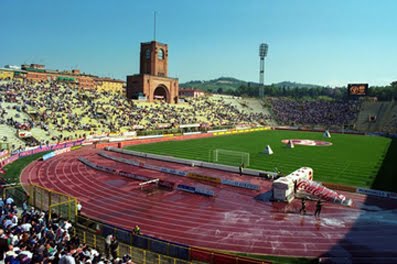
The stadium in Bologna Italy, parties taking place here at home team with the same name. It was inaugurated in 1927 and has a capacity of 38,279 seats. It was modernized several times and parties hosted at World Cup final tournaments of 1934 and 1990.
Source - sport-campina.blogspot.com
Palermo stadium - Stadio Renzo Barbera

Renzo Barbera Stadium ( La Favorita) is a football stadium in Palermo, Italy. Renzo Barbera stadium inaugurated on January 24, 1932 and was named Stadio Littorio in homage to Fascism. Palermo is a football club wearing the Renzo Barbera stadium.
source - rudsoccers.com
Monday, April 16, 2012
Atalanta stadium - Atleti Azzurri d'Italia

Atleti Azzurri d'Italia is a stadium in Bergamo, Italy, used by the Atalanta and Albinoleffe football teams. The field is 120 m long, and 70 m wide. The stadium has officially 24,642 recognized seats.
The stadium is seen by many to be outdated and not up to standard for Serie A due to poor facilities, poor views from a number of stands and because most of the stadium has no roof cover.
Chievo stadium - Marco Antonio Bentegodi
Stadio Marc'Antonio Bentegodi is a stadium in Verona, Italy. It is the home of both Chievo Verona of Serie A and Hellas Verona of Serie B.
Inaugurated as a state-of-the-art facility and as one of Italy's finest venues in 1963, the stadium appeared excessive for a team (Hellas) that had spent the best part of the previous 35 years in Serie B. For the 1990 FIFA World Cup renovations included an extra tier and a roof to cover all sections, improved visibility, public transport connections, an urban motorway connecting the city centre with the stadium and the Verona Nord motorway exit and services.


Inaugurated as a state-of-the-art facility and as one of Italy's finest venues in 1963, the stadium appeared excessive for a team (Hellas) that had spent the best part of the previous 35 years in Serie B. For the 1990 FIFA World Cup renovations included an extra tier and a roof to cover all sections, improved visibility, public transport connections, an urban motorway connecting the city centre with the stadium and the Verona Nord motorway exit and services.


Catania Stadium - Stadio Angelo Massimino
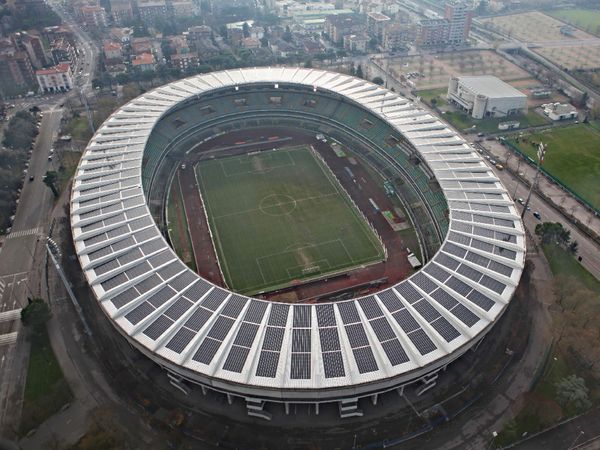
The stadium was built in 1937 and can accommodate 23 420 spectators. During the Universiade in Sicily in August 1997 found the athletics competitions held in Catania. To this end, the stadium was renovated. In 2002 it was named after the chairman of Catania, Angelo Massimino. After clashes between the fans of Catania and Palermo outside the stadium, which ended with the death of Filippo Raciti the police, were allowed on 14 February 2007 to 30 June 2007 no games of the Serie A at the Stadio Angelo Massimino will be held.


source - superficiala.com


source - superficiala.com
Subscribe to:
Posts (Atom)