18:00 Mallorca - Zaragoza
18:00 Sporting Gijon - Rayo Vallecano
20:00 Barcelona - Real Madrid (DERBY)
22:30 Sevilla - Levante
Showing posts with label Spain. Show all posts
Showing posts with label Spain. Show all posts
Saturday, April 21, 2012

Saturday, April 14, 2012
Estadio El Sardinero de Santander - Racing Santander Stadium
The Estadio El Sardinero Santander is also the home of Racing in that city, one of the sports most welcoming of Spanish football, being built on land they owned to his predecessor, the same name.
It has one of the best views on the field in Spain by not having the support columns for its base, and around the stadium are the club's headquarters, as well as the official store of the same.


www.blogestadios.blogspot.com
It has one of the best views on the field in Spain by not having the support columns for its base, and around the stadium are the club's headquarters, as well as the official store of the same.


www.blogestadios.blogspot.com
Estadio La Romareda - Real Zaragoza Stadium
The Romareda Stadium is the football field where he plays for Real Zaragoza from the September 8, 1957 date that is opened in Zaragoza, Osasuna game would win the hand set 4-3. Currently has a capacity for 34,596 spectators.
It owes its name to the fact that it is in the neighborhood of La Romareda Zaragoza and replaces the old stadium Torrero.
It has hosted two major sporting events played in Spain, World Cup Soccer 1982 and the Olympic Games in Barcelona 1992.
For the 1982 World Cup stadiums would be like so many of Spain renovated to host this event so he made a partial facelift. Would host 3 matches in the group stage, namely the E, but the Spanish team would not play any match in La Romareda.


Source - yotufutbol.com
It owes its name to the fact that it is in the neighborhood of La Romareda Zaragoza and replaces the old stadium Torrero.
It has hosted two major sporting events played in Spain, World Cup Soccer 1982 and the Olympic Games in Barcelona 1992.
For the 1982 World Cup stadiums would be like so many of Spain renovated to host this event so he made a partial facelift. Would host 3 matches in the group stage, namely the E, but the Spanish team would not play any match in La Romareda.


Source - yotufutbol.com
El Molinon - Sporting Gijón Stadium
Estadio El Molinón is an association football stadium in Gijón, Asturias-Spain. The stadium is the home ground of Sporting de Gijón.
The stadium's address is Parque de Isabel la Católica, 33390 Gijón.


Photos - mayfairglobalevents.com
The stadium's address is Parque de Isabel la Católica, 33390 Gijón.


Photos - mayfairglobalevents.com
Estadio El Madrigal - Villarreal CF Stadium
Villarreal Club de Fútbol is a football club, as a corporation organized sports, the Spanish city of Villarreal in the province of Castellón. Currently plays in the Primera Division in Spain. Traditionally it is considered that was founded on March 10, 1923, when he began his career on C. D. Villarreal, although the origin of this institution dates back to 1942 when Athletic Club Foghetecaz emerged.
One of his greatest international accomplishments, and history was in the 2005-2006 season in the Champions League of UEFA, which reached the semifinals, becoming the best team rookie of the competition under the name of the hand of DT Manuel Pellegrini, the most successful coach in club history.


Photos at azulonesypunto.foroactivo.com
One of his greatest international accomplishments, and history was in the 2005-2006 season in the Champions League of UEFA, which reached the semifinals, becoming the best team rookie of the competition under the name of the hand of DT Manuel Pellegrini, the most successful coach in club history.


Photos at azulonesypunto.foroactivo.com
Granada 74 CF Stadium - Estadio Nuevo Los Cármenes
The football stadium in Granada Spanish town that hosts parties at home of FC Granada, working in the Spanish league. It was inaugurated on May 16, 1995 and has a capacity of 16,212 seats.
Foto & text - sport-campina.blogspot.com

Foto & text - sport-campina.blogspot.com

Estadio Anoeta - Stadium Real Sociedad
Estadio Anoeta is the home of Real Sociedad. The stadium has a capacity of 32,000 seats.
Estadio Anoeta opened on the 13 of August 1993 and replaced Real Sociedad’s previous home Estadio de Atocha which had become too small and outdated for the times. The stadium served as a host for the European Youth Athletics Championships held in 1993, and as a result has athletics tracks circling the pitch.
Photos at real-sociedad-sad.es


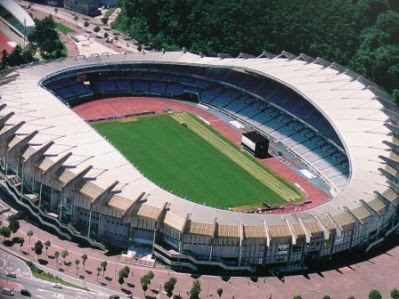
Estadio Anoeta opened on the 13 of August 1993 and replaced Real Sociedad’s previous home Estadio de Atocha which had become too small and outdated for the times. The stadium served as a host for the European Youth Athletics Championships held in 1993, and as a result has athletics tracks circling the pitch.
Photos at real-sociedad-sad.es


Estadio Manuel Ruiz de Lopera - Stadium Betis Sevilla
Stadium in Seville, where they played their home matches Real Betis Sevilla band. It is a stadium built in 1929, renovated several times, and now has a capacity of 52,745 seats.


Stadium Rayo Vallecano - El Campo de Fútbol de Vallecas
Football Field Vallecas is the football stadium where he plays the Ray Vallecano. Located in the popular neighborhood of Vallecas, southeast of Madrid (Spain) is located between the streets Clown Fofó, Arroyo del Olivar y Avenida de la Albufera.
It was built in 1973 in the same place where the old stadium, and can accommodate 14,708 spectators. Formerly the lower grandstand seats were up and could have capacity for 20,000 people, but UEFA in 1996 changed the rules of stadiums for First and Second Division, and thus stood at 15,500 seats to the renovation work that suffered the stadium in 2011 to remove the fences separating the pitch from the stands, leaving the current capacity for 14,708 spectators.
At first it was called New Stadium Vallecas. In 1992 Ruiz-Mateos family bought the club and Teresa Rivero in 1994 became the first woman president of a football club first division. A few years later, in 1999, subscribers of the Club approved a referendum to pass to the stadium called "Soccer Field Vallecas, Teresa Rivero."
Photos - www.stadiumguide.com


It was built in 1973 in the same place where the old stadium, and can accommodate 14,708 spectators. Formerly the lower grandstand seats were up and could have capacity for 20,000 people, but UEFA in 1996 changed the rules of stadiums for First and Second Division, and thus stood at 15,500 seats to the renovation work that suffered the stadium in 2011 to remove the fences separating the pitch from the stands, leaving the current capacity for 14,708 spectators.
At first it was called New Stadium Vallecas. In 1992 Ruiz-Mateos family bought the club and Teresa Rivero in 1994 became the first woman president of a football club first division. A few years later, in 1999, subscribers of the Club approved a referendum to pass to the stadium called "Soccer Field Vallecas, Teresa Rivero."
Photos - www.stadiumguide.com


Stadium RCD Mallorca - El Lberostar Estadi
In August 1999, the RCD Mallorca premiered their new stadium, Son Moix, replacing the old Lluís Sitjar, opened in 1945. The new feud mallorquinista stood at Cami dels Reis in The Vileta, Palma de Mallorca (Baleares) and with a capacity greater than that offered by the old stadium.
Thanks to the agreement signed with the city of Palma on December 15, 1997, RCD Mallorca secured the exclusive use with the stadium being built for the celebration of Palma Universiade '99.
Since 2004 and with a contract in force until June 2010, the enclosure of RCD Mallorca ONO Stadium renamed due to advertising agreement with the telephone company. Located next to Ca'n Valero industrial estate about two miles from the center of Palma, consists of four stands, sun deck and north-south depth with capacity for 23,142 spectators and all the necessary facilities that make it an facility comparable to the most modern in Europe.


Thanks to the agreement signed with the city of Palma on December 15, 1997, RCD Mallorca secured the exclusive use with the stadium being built for the celebration of Palma Universiade '99.
Since 2004 and with a contract in force until June 2010, the enclosure of RCD Mallorca ONO Stadium renamed due to advertising agreement with the telephone company. Located next to Ca'n Valero industrial estate about two miles from the center of Palma, consists of four stands, sun deck and north-south depth with capacity for 23,142 spectators and all the necessary facilities that make it an facility comparable to the most modern in Europe.


Estadio Coliseum Alfonso Pérez - Stadium Getafe CF
Getafe Club de Fútbol S.A.D. is a Spanish La Liga football club based in Getafe, a city in the Madrid metropolitan area, founded in 1946 and refounded in 1983.
In the top level since 2004-05, it holds home games at the Coliseum Alfonso Pérez.


In the top level since 2004-05, it holds home games at the Coliseum Alfonso Pérez.


Stadium Athletic Bilbao - Estadio San Mamés
Construction of the stadium began in 1912 and on the 21st of August 1913 the stadium officially opened with a match between Athletic Club and the Spanish champions of that year, Racing Club de Irun. The stadium counted with a capacity of 7,000 places at its opening.
The ground got gradually expanded in the following decades, however the most significant developments date from 1953 when the main stand, with its characteristic arch, was constructed. In the 20 years that followed the other three stands too were to be completely rebuilt.
A last major renovation was performed for the 1982 World Cup, during which Bilbao was one of the host cities. Three matches during the first group phase were played at the stadium.


The ground got gradually expanded in the following decades, however the most significant developments date from 1953 when the main stand, with its characteristic arch, was constructed. In the 20 years that followed the other three stands too were to be completely rebuilt.
A last major renovation was performed for the 1982 World Cup, during which Bilbao was one of the host cities. Three matches during the first group phase were played at the stadium.


Estadio Ramon Sanchez Pizjuan - Stadium Sevilla FC
Stadium where he held the 1986 European Cup final between Steaua Bucharest and Barcelona, but also where to play World Cup semifinal in 1982 between France and Germany.
The stadium Spain has not lost any international match.
The stadium is nicknamed "La Bombonera" (better known under that name is Estadio Alberto J. Armando as the Boca Juniors stadium) or "La Bombonera of Nervion" because he is in headquarters Nervion.


The stadium Spain has not lost any international match.
The stadium is nicknamed "La Bombonera" (better known under that name is Estadio Alberto J. Armando as the Boca Juniors stadium) or "La Bombonera of Nervion" because he is in headquarters Nervion.


Estadio Osasuna Pamplona - Stadium Reyna de Navarra
Also known as "El Sadar" stadium in the Spanish city of Pamplona is hosting parties at home team Osasuna Pamplona. It was inaugurated on September 2, 1967, modernized in 1989 and 2003, having now a capacity of 45,488 seats.


Estadio Mestalla - Stadium Valencia
Estadio Mestalla is a football stadium in Valencia, Spain. It is the home stadium of football club Valencia CF. It has a capacity of 53,000 seats (v'ek session) and is the fifth největ'ím stadium in Spain. It is also renowned for its steep terrace and roaring atmosphere at matches. (In 2009, the club is waiting v'ak moving to a new stadium - the Nou Mestalla. New stadium should have a capacity of 75,000 spectators.) 20 May 1923 was inaugurated a friendly match between Valencia CF home and Levante UD. It was the beginning of a new era, which ended the old působi'ti, Algirósu that will always remain in our memories fanou'ků Valencia as the first. The history of the stadium dates back to ancient times, when Valencia played je'tě Primera Division. At the stadium could only accommodate 17 000 spectators (vět'ina or sit), but the club began to show its potential, especially in home 'Champion, forcing the club to implement changes to the stadium early - in 1927. Stadium capacity increased to 25,000 seats, but before it was demolished stadium je'tě result of the civil war. Mestalla was also used as unfortunately skladi'tě waste. To avoid this, one needed only to strengthen fences and generally unavailable to unauthorized persons stadium. Once renovated stadium, the team began to flourish. In 1941, he could enjoy his first team title in the league. Valencia played a "huge" and after reconstruction dal'í players to chase on a new, kvalitněj'ím lawn. In dal'ích years, thanks to legends like Epi, Amadeo, Mundo, Asensi and Guillermo Gorostiza, 3 team won league titles and two league cups. These years of great success not only greatly famous club, but also the stadium. During the fifties největ'í stadium has undergone changes in its history. These changes resulted in the stadium with a capacity of 45,500 spectators. This stadium, but probably not much desire; in 1957, severe floods hit the city. Yet v'ak the club was able to muster, not only correct the "damage inflicted by floods, and even added some vylep'ení, such as artificial lighting, which was first used in Fallaských celebrations in 1959. It was dal'í step towards a new era stadium. In 'edesátých stadium's appearance has not changed, but look at the city and its surroundings are. Even so changed that it was considered one of the places in Europe nejpohledněj'ích (that resulted in more tourists and thus also vět'í náv'těvnost stadium). The first foreign team that played at the Mestalla official match was Nottingham Forest. The match was played on the 15th September 1961 and was the first encounter so-called golden times full of successes, reinforced je'tě Fairs Cup victory in 1962 and 1963. Mestalla so rightfully began divided between the stadiums where they took place nejdůležitěj'í the football games. Since 1969, the term "Anem a Mestalla" (Let's go to Mestalla) between fanou'ky club ceased to use it. The reason for renaming the stadium, which would mean the recognition by the club donated his největ'í icon (Luis Casanova Giner - President), who worked at the club nearly a quarter century. Luis Casanova Giner but admitted that he was completely taken aback by such a tribute and in 1994 he demanded that the Mestalla stadium called again.


Vicente Calderon - Stadium Atletico Madrid
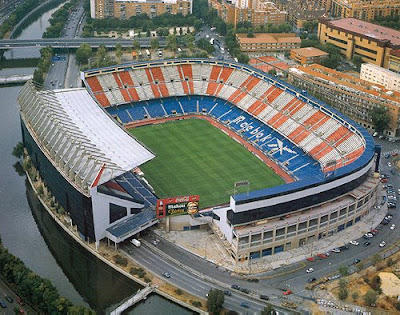
Whilst smaller than the stadium of city rivals real Madrid the Atletico Madrid stadium is both more modern, having been constructed in 1966 and cheaper to get in to. See here for Atletico Madrid stadium prices.
madrid-guide-spain.com


madrid-guide-spain.com


Subscribe to:
Posts (Atom)